




What happens when a startup postpones SEO for a year? Usually, paid acquisition keeps getting more expensive while the site still has little organic visibility. The cause usually hides in the work order, and it’s fixable.


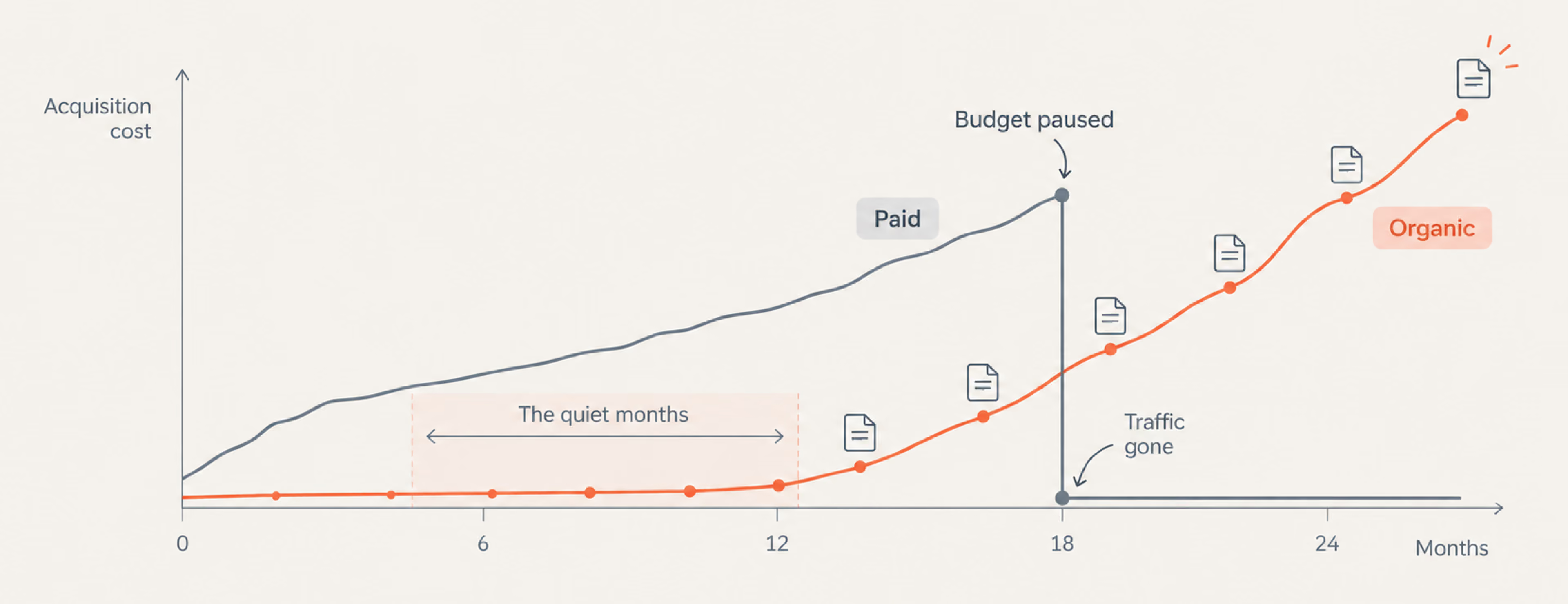
Early-stage companies live with two constraints at once: a short runway and a market that hasn’t heard of them yet. Paid channels solve the second problem quickly, but every visitor costs money, and when the budget stops, traffic does too. Organic search takes longer to build, but a page that earns visibility can continue bringing in relevant traffic without paying for every visit.
Below, you’ll find what SEO for startups means in practice, the myths that waste the most time and money, and a step-by-step system a small team can run.
{{banner}}
What SEO for startups really means
For a startup, SEO is the work of making your product findable for the exact problems future customers search for. The fundamentals are the same as in any SEO strategy, but the priorities are different when resources are limited, and there’s little brand recognition to lean on.
An enterprise site defends rankings it has built over a decade, so its main risk is losing ground. A local SMB competes for a handful of service-area terms (“accountant in Austin”) against a few nearby rivals. A startup often starts with much less search authority and a market that is still taking shape. In newer categories, buyers may not even know what to call the solution yet.
That last point shapes the whole strategy. If you’re building a new type of product, people won’t search for your category name. They search for the problem, like “how to stop invoices getting lost between teams,” for workarounds, or for alternatives to a tool they already dislike. SEO for a startup business starts with those queries — the initial sources of early demand.
Search is changing too. Google’s AI Overviews, ChatGPT, and Perplexity can now answer many straightforward questions without sending users to another page. A Pew Research Center study found that users clicked a traditional result in 8% of visits when an AI summary appeared, compared with 15% when it didn’t. Buyers are also doing more research through fewer, more specific searches, often asking detailed questions instead of working through a long list of broad keywords.
As a result, a page that ranks for a broad definition may get summarized and skipped. Meanwhile, a page that answers a specific commercial question in depth has a better chance of earning the click when someone still needs more than a summary. That’s why SEO works best at this stage as a growth system connected to positioning, sales conversations, and pipeline. If your site is brand-new, our 7 SEO tips to boost your new website’s rankings cover the groundwork to put in place first.
Why SEO is a strategic investment for startups
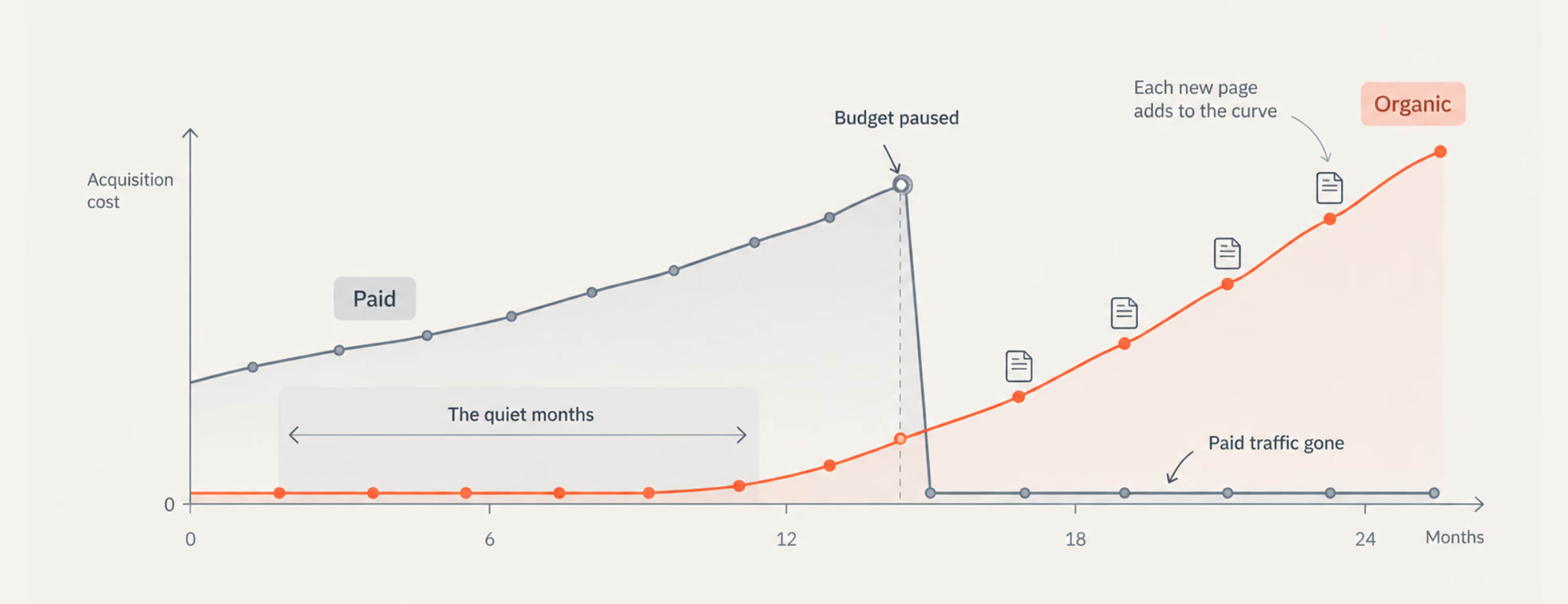
SEO’s value is not always obvious in the first few months, especially next to channels that produce faster feedback. But there are a few reasons it can become a much more important growth investment over time.
Compounding growth vs. paid acquisition dependency
Paid channels are beneficial when a startup needs traffic quickly, but they keep requiring budget to maintain that traffic. As competition increases, acquiring the same customer can also become more expensive.
SEO has a different cost curve. The upfront work goes into research, content, technical improvements, and distribution, while a page that continues to rank can keep bringing in relevant visits without paying for each one. Over time, a stronger site also gives new pages more to build on through existing links, topical coverage, and internal structure. That does not make organic traffic free, but it can reduce how dependent growth is on paid acquisition.
SEO gets more useful when you’re no longer starting from zero every month.
Demand capture vs. demand creation
Search is strongest when people already know enough about a problem to look for an answer. A query like “expense tracking software for remote teams” shows much more intent than an impression in a social feed.
That matters for startups creating a new category. Ads, founder content, PR, and social can introduce the problem or idea first. SEO becomes more valuable once people start researching it, comparing approaches, or looking for alternatives. If your company is absent from those searches, the interest created elsewhere can still end up benefiting a competitor.
Building credibility before brand awareness
A new brand rarely gets the benefit of the doubt. Before booking a demo or replying to outreach, buyers may search the problem, compare options, or look up the company itself.
Useful guides, comparison pages, original data, and clear product content give them something concrete to judge. First-hand examples and specific evidence matter more here than generic advice, because they show that the team has actually worked with the problem it is writing about.
Search visibility as investor and partner validation
Search also shapes what people see when they research the company outside the buying journey. Investors, potential partners, journalists, and candidates may look up the brand, its founders, its category, or the problems it claims to solve.
A credible search footprint gives them more context: useful company pages, relevant third-party mentions, expert content, and clear positioning alongside established players. SEO will not validate the business on its own, but it can make the company easier to assess when someone decides to look deeper.
Common SEO myths that cost startups time and money
A lot of wasted SEO effort starts with assumptions that sound sensible at first. These are four of the ones that tend to cause the most trouble for startups.
We need high-volume keywords first
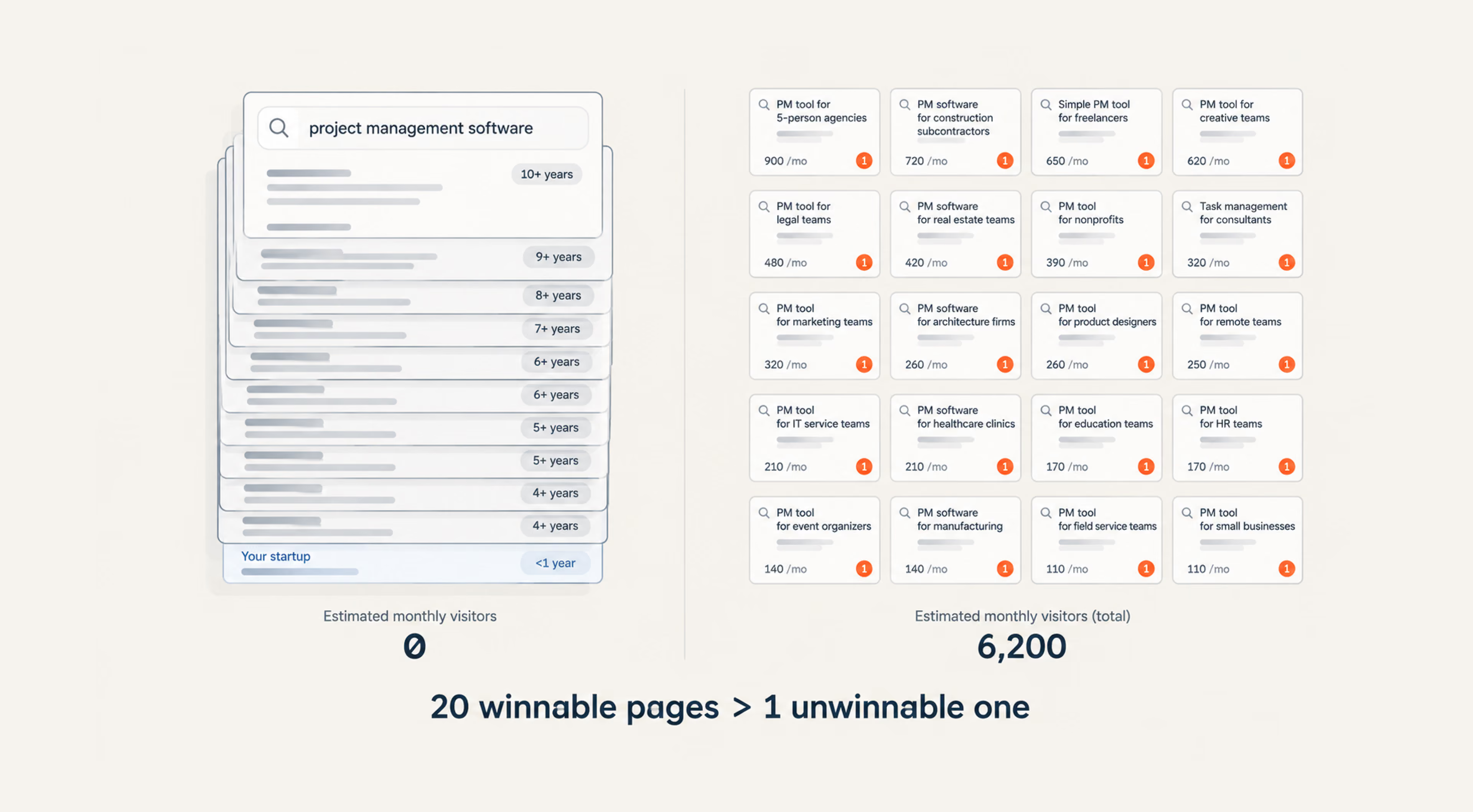
Big search volumes are tempting, but they are rarely the best place for a new site to start. A query like “project management software” puts a startup up against established brands, review platforms, and sites that have been earning links for years.
More specific, lower-volume queries usually give a younger domain a better chance to compete. They also tend to reveal more about what the searcher actually wants, which makes it easier to create a page around a clear need rather than a broad topic.
SEO is dead because of AI and ads
AI answers have reduced clicks for some simple informational searches, and that shift is real. But AI tools still rely on information from websites, so creating useful, well-structured content remains important. Pages with clear answers, relevant details, and credible sources can still earn visibility in search and may also surface as sources in AI-generated answers.
Ads haven’t replaced organic search either. They can put a company in front of people quickly, but they don’t cover every question buyers ask while researching a product. For startups, that makes SEO less about publishing as much content as possible and more about creating specific pages that answer the questions their customers actually search for.
Publishing content is enough
Content is one part of SEO, but publishing more articles won’t fix problems elsewhere on the site. A blog with 50 articles can still struggle if Google can’t crawl the pages, several posts target the same topic, or important pages have no internal links pointing to them. Content needs to work alongside technical SEO, site structure, internal linking, and links from other relevant websites.
A useful test before publishing anything: which query is this page for, what do the current top results leave unanswered, and how will a reader get from this page to your product? If you can’t answer all three, the page isn’t ready yet.
SEO only works with big budgets
A bigger budget can speed up SEO, but you don’t need one to start. Google Search Console and Google Analytics are free, and founders often know their customers’ problems better than an outside writer. That knowledge can lead to more useful, specific content.
When resources are tight, the main job is deciding what is worth doing now and what can wait. A small team can still make progress by choosing a few high-intent topics, fixing the issues that block visibility, and giving each new page enough time and attention to be useful.
What are the different types of SEO for startups?
SEO for a startup company covers several disciplines that support each other. You won’t need all of them at full intensity from day one, but it helps to know what each does and when it becomes relevant (our overview of what SEO services include goes into more detail):
- On-page SEO. Optimizing individual pages (title tags, meta descriptions, a logical H1–H3 structure, descriptive image alt text, and internal links with clear anchors). Halo Lab’s on-page SEO services handle this work for teams without an in-house specialist.
- Technical SEO. For startups, the main goal is to keep basic site issues from blocking growth. Important pages should be easy to crawl and index, perform well, and avoid problems such as duplicate URLs, broken canonicals, or poor mobile performance. More complex sites may need dedicated technical SEO services.
- Content-driven SEO. Customer questions can become search entry points when they’re turned into useful pages. Depending on the product, that may mean use-case pages, comparisons, alternatives, or guides built around problems buyers already search for.
- Off-page SEO and authority signals. New domains usually have little history behind them, so relevant mentions elsewhere carry more weight. Editorial links, digital PR, reviews on platforms like G2 or Capterra, and genuine mentions in industry communities can all strengthen that external credibility.
- Local SEO. Location only needs to become a major SEO priority when it shapes how people search for the business. For startups serving specific cities or regions, that usually means an accurate Google Business Profile, consistent business details across directories, and a steady base of local reviews. Our local SEO services focus on this type of visibility.
- International SEO for scaling startups. Expanding into new countries or languages adds another layer of complexity. Beyond translation, teams need to decide how markets are structured on the site, use hreflang correctly, and adapt pages to local search behavior.
- SEO analytics and performance measurement. Tracking impressions, clicks, rankings, organic conversions, and backlink growth, so every other type of SEO can be judged by its actual results.
For most early-stage startups, technical and on-page work come first, with content close behind. Authority building can start once there are pages worth earning links and mentions to.
How to do SEO for startups: a step-by-step system
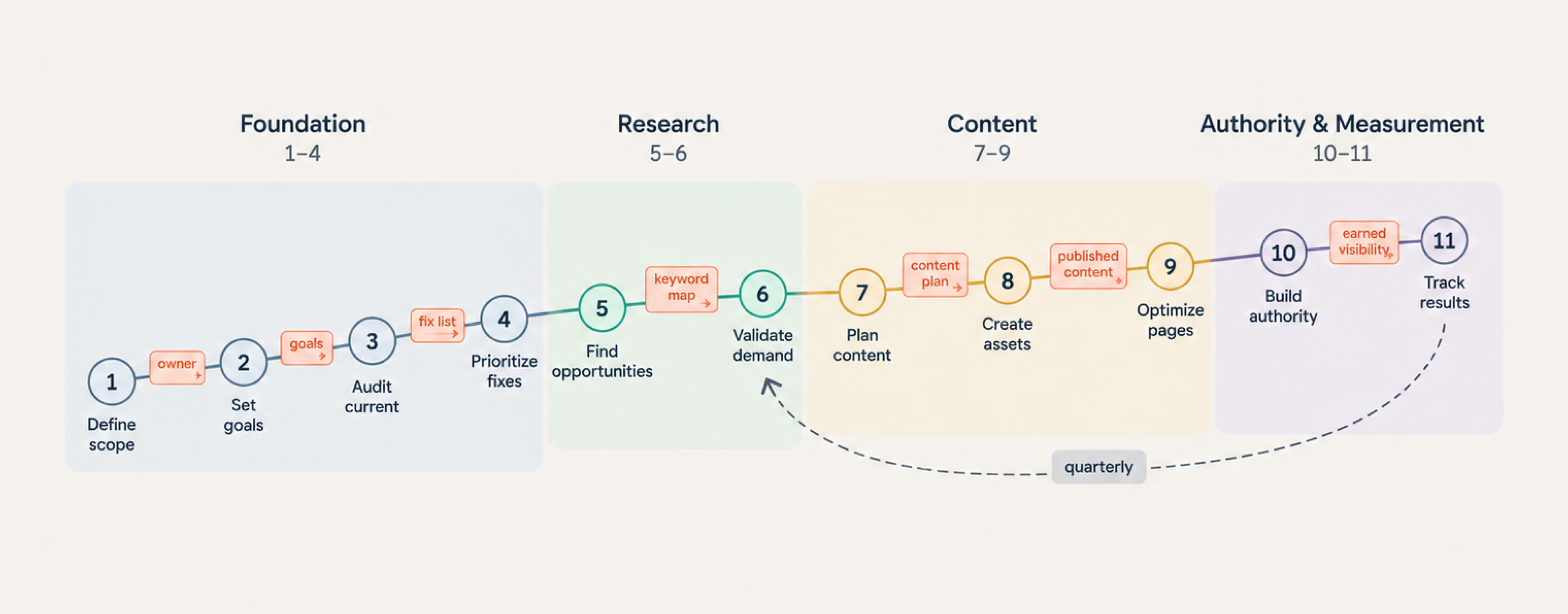
Here’s a startup SEO sequence that can be helpful for early-stage teams. The order matters, because each step produces the inputs the next one needs.
Step 1 — Secure buy-in and define SEO ownership
Someone needs to own SEO, even if several people are involved in the work. That might be a founder, growth marketer, or product lead who decides what gets prioritized, keeps track of progress, and brings in developers or writers when needed.
The bigger challenge is making room for SEO alongside everything else competing for attention. A technical fix or new landing page can easily sit in the backlog for months if nobody is responsible for moving it forward. Agree early on who makes those calls and what support they can expect from the rest of the team.
Step 2 — Set realistic SEO goals and timelines
Revenue is usually a poor early signal of whether SEO is moving in the right direction. Start by watching what happens before the conversion: are important pages getting indexed, are impressions growing, and are relevant queries beginning to move up?
Then connect that progress to the action that matters for the business. For a self-serve product, that might be trial starts; for a sales-led company, demo requests or qualified pipeline. The point is to know what you expect SEO to influence before the numbers arrive, rather than choosing the metric that looks best later.
Step 3 — Allocate resources and tools efficiently
A lean toolkit covers nearly everything SEO for a startup company needs early on:
- Google Search Console to see how Google finds the site, which queries trigger impressions, and where indexing problems appear.
- Google Analytics 4 to connect organic visits with what people do after they land.
- An SEO platform such as Ahrefs, Semrush, or SE Ranking for keyword, competitor, and backlink research.
- A crawler like Screaming Frog for checking the site at the page level.
You don’t need a large stack at this point. What matters more is having someone who can use the data regularly and enough writing and developer capacity to act on what it shows.
Step 4 — Run a technical SEO audit and fix blockers
Before creating new pages, make sure the existing ones can be found. Crawl the site and look for these problems:
- pages blocked from indexing by mistake;
- broken links or redirects that send crawlers in circles;
- duplicate URLs with unclear canonical signals;
- sitemap issues that make important pages harder to discover;
- slow or unstable page templates.
Google’s Core Web Vitals are useful here as a performance baseline: LCP should be 2.5 seconds or less, INP 200 milliseconds or less, and CLS 0.1 or less.
Startups built on JavaScript frameworks should also check that important content is present in the rendered HTML Google receives. JavaScript is not automatically a problem, but rendering issues can still keep key content or links from being discovered as expected.
Prioritization matters here too. When we audited a tutoring service, we split technical issues into three tiers: fix now, address during the upcoming redesign, and safe to postpone. Over the following year, the site grew organic traffic by 28%, while 46% of the tracked keywords reached the top 3.
{{banner-2}}
Step 5 — Perform competitor and SERP analysis
In startup SEO, your search competitors aren’t always your business competitors. Search your target queries and note who actually ranks. Review platforms, media sites, and adjacent tools often hold positions you’ll have to contend with.
For each relevant rival, look at which pages bring them the most traffic, which topics they cover that you don’t, and which sites link to them. Then study the results pages themselves. Whether Google shows listicles, product pages, tutorials, or videos gives you a good sense of the format already winning for that search. Our SEO competitor analysis guide walks through the process tool by tool.
Step 6 — Do keyword research mapped to search intent
Customer language is usually the best place to begin. Pull terms from sales calls, support tickets, onboarding questions, and reviews of competing products, then use a keyword tool to see how that language shows up in search.
From there, group the queries by what the person is trying to do:
- Informational: “how to reduce SaaS churn”
- Commercial: “best churn analytics tools for startups”
- Transactional: “churn analytics software pricing”
- Comparison: “[competitor] alternatives”
For a new site, the most useful opportunities are often the ones closest to a real buying decision. Broader informational topics still matter, but they usually play a longer game. Prioritize by business value first, ranking difficulty second, and volume third. For a deeper breakdown, see our guide to SEO keywords.
The right keyword for a startup is one its product can win and its buyers actually type.
Step 7 — Build a scalable content plan
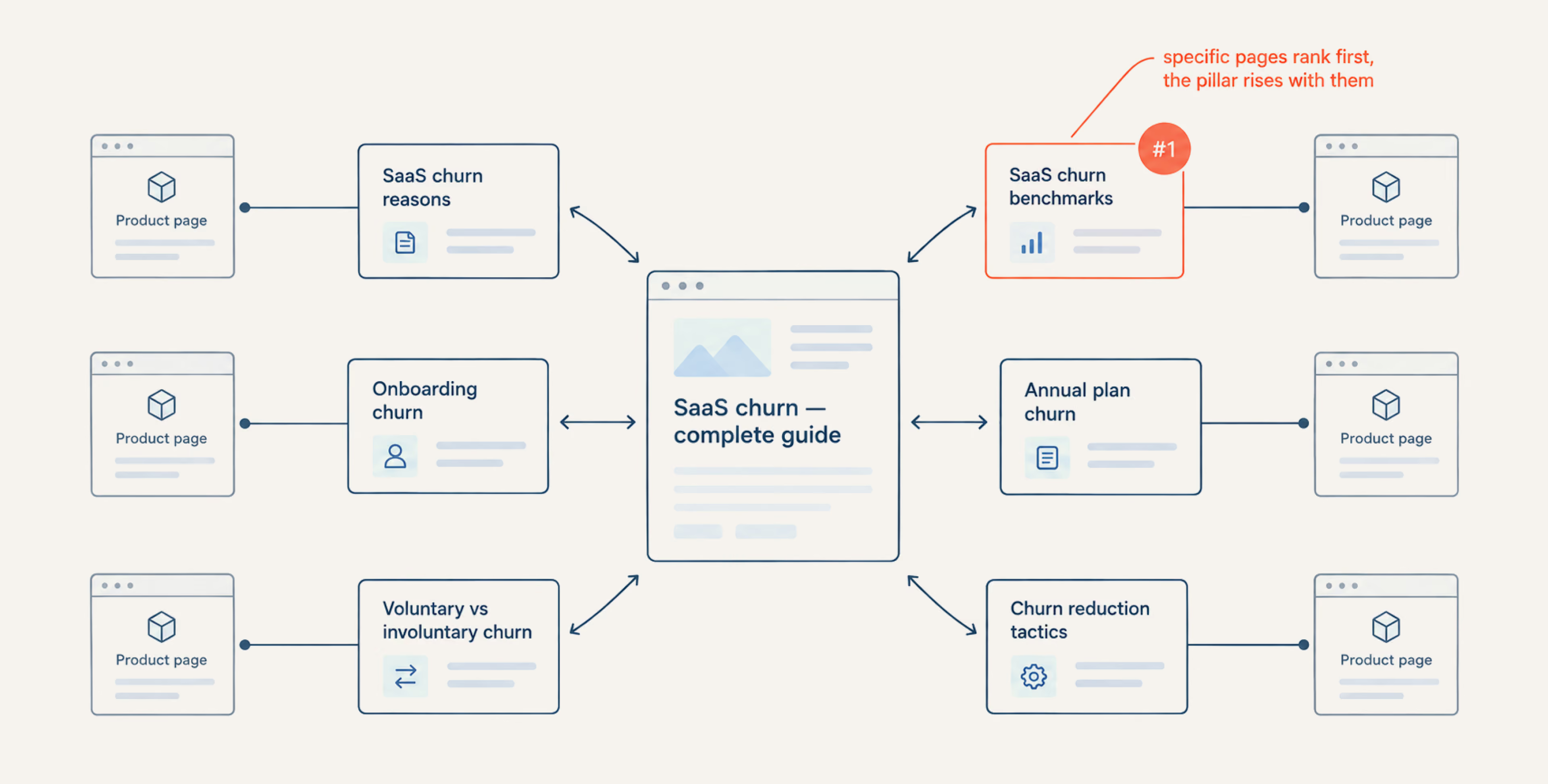
Organize your keywords into topic clusters. From there, look for groups of queries that belong to the same customer problem and decide which ones deserve their own page. Related pages should connect naturally through internal links instead of sitting as isolated posts.
The publishing pace should match what the team can actually sustain. A shorter calendar with time for research, review, and updates is more useful than filling three months with topics just to hit a volume target. For each planned page, note the target query, intent, format, and where the reader should go next.
Step 8 — Create high-value, intent-driven content
Before writing, look at what someone can already find for the query. The goal is not to make the same article longer, but to add something useful that is missing: product data, a real example, original screenshots, a template, or experience from doing the work yourself.
Make the answer easy to find once the reader lands on the page. Put the important point early, use headings that say what each section is actually about, and add follow-up questions only when they help the reader. The next step should fit the page too — someone comparing tools is much closer to a demo than someone who has only just started researching the problem.
Step 9 — Optimize existing pages and content assets
Once pages have a few months of data, Search Console turns into a to-do list. Look for queries where you rank in positions 8–20. These pages are close to page one and often need only a sharper title, an extra section, or stronger internal links.
Refresh content that’s losing clicks as well: update statistics, screenshots, and product details, and merge thin pages that compete for the same query. Quite often, the shortest route to more organic traffic is a page you already have, not another one added to the calendar.
Step 10 — Earn authority through links and mentions
Relevant links and mentions can make a real difference, especially for a young site with little authority of its own. Startups have several natural sources of them:
- Launch coverage in industry media and product communities
- Original data, such as benchmarks drawn from anonymized product usage
- Founder expertise shared through podcasts, guest articles, and quotes for journalists
- Integration pages, partner directories, or ecosystem listings where your product genuinely belongs
- Reviews and profiles on platforms buyers in your category actually use
Be careful with link packages sold purely for rankings. Google treats paid links intended to manipulate search positions as link spam; sponsored placements need to be qualified appropriately.
Step 11 — Track, measure, and reoptimize continuously
Once pages are live, the data should start changing what you do next. Check which queries are gaining visibility, which pages bring in conversions, and where promising rankings have stalled. It also helps to separate branded and non-branded search so you can see whether SEO is reaching people who were not already looking for the company by name.
Use those patterns to adjust the plan rather than sticking to the original calendar. Topics that bring qualified traffic may deserve more coverage; pages that sit still may need a different angle, stronger internal links, or consolidation. If the tracking itself needs work, our Google Analytics 4 setup service can help.
SEO mistakes startups commonly make
Most SEO mistakes at the startup stage come from doing too much too early, or measuring the wrong thing once the work is underway. These are the ones worth watching for.
Scaling content before validating demand
Publishing capacity is no longer the hard part. A team can now produce dozens of pages before it has proved that people are actually searching for those topics or that the pages lead anywhere useful.
Start smaller. Test a few closely related topics, see which ones earn relevant impressions and conversions, and only then expand. Scaling a weak idea usually just creates more pages to maintain later.
Ignoring internal linking and crawl depth
A useful page can still underperform if it sits several layers deep with few links pointing to it. That makes it harder for both crawlers and readers to reach.
Important pages should be easy to find from relevant parts of the site. When you publish something new, look for older pages that should link to it, and make the anchor text clear enough that a reader knows where the link leads.
Chasing backlinks without relevance
Not every backlink is worth having. A mention from a site your buyers actually read can be far more useful than a long list of links from unrelated directories.
Before pursuing a link, ask whether the placement makes sense for the product and whether the audience behind it is relevant. If the only reason the link exists is to influence rankings, it is probably not a good use of time.
Measuring vanity metrics instead of impact
More impressions or a high ranking for a broad keyword can look impressive in a report without changing anything for the business.
Look past the headline numbers. Which organic pages generate sign-ups, demo requests, qualified leads, or assisted pipeline? If traffic keeps growing but those outcomes do not, the issue may be the queries you are targeting rather than the amount of traffic itself.
Treating SEO as a one-time project
A launch-day optimization pass does not stay current forever. The product changes, competitors publish new pages, old content becomes outdated, and search results shift.
SEO needs some ongoing maintenance: reviewing performance, updating pages that have slipped, fixing new technical issues, and deciding what deserves attention next. It does not need constant rebuilding, but it does need an owner and a regular review cycle.
How long SEO takes for startups
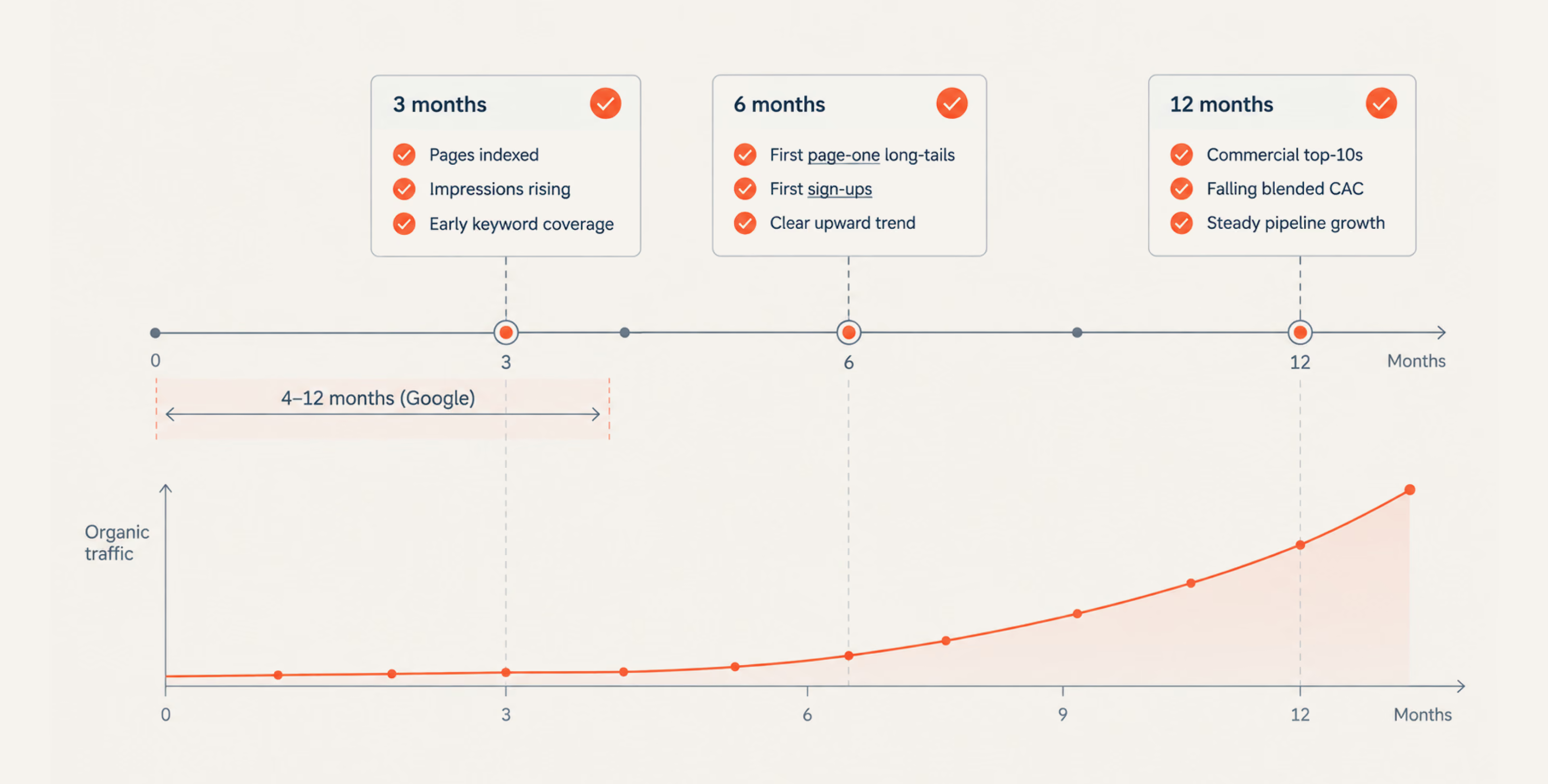
There is no fixed SEO timeline for a startup. A new site in a narrow niche can move faster than one entering a crowded category, and technical issues can delay even a strong content plan. Google’s own guidance notes that SEO work typically needs four months to a year to be implemented and start showing benefits, which is a useful reminder to judge progress over months rather than weeks. Our guide on how long SEO takes looks at those variables in more detail.
Early traction vs. sustainable growth
The first signs of progress are usually small. A few relevant queries start moving up, impressions grow, and certain pages begin bringing in their first organic visits or conversions.
That is different from having a dependable organic channel. Sustainable growth takes longer because it depends on more than a handful of rankings. The site needs enough useful coverage, authority, and ongoing maintenance for results to hold and expand over time.
Factors that accelerate or delay results
Timelines vary a lot from one startup to another. Results usually come faster when you start with:
- a technically clean site from launch;
- a focused niche where competitors are weak or generic;
- visible, first-hand expertise in the content;
- a steady publishing and updating rhythm;
- early press, partner, or community mentions.
Progress usually takes longer when you are dealing with:
- a brand-new domain with little existing authority;
- a highly competitive category;
- indexing, rendering, or site-structure problems;
- generic content that adds little beyond what already ranks;
- long gaps between publishing, updates, and technical work.
What success looks like at 3, 6, and 12 months
These are better treated as signs to look for than fixed benchmarks:
- Around 3 months: important pages are indexed, major technical blockers are out of the way, and relevant impressions or ranking queries are starting to grow.
- Around 6 months: some pages are earning more consistent visibility, organic traffic is beginning to convert, and the team has enough data to see which topics deserve more investment.
- Around 12 months: stronger commercial pages may be competing for valuable queries, organic search can be contributing more meaningfully to acquisition, and new content has a clearer base to build from.
If progress is slower, that does not automatically mean the strategy has failed. It usually means the starting conditions, competition, execution, or targeting need another look. The longer-term upside is real: one of our e-commerce clients grew organic search from 5% of sales into a scalable acquisition channel over 12 months.
Keep your SEO moving as your startup grows
By the time a startup has enough data to make perfect SEO decisions, the market has usually moved again. Waiting for certainty is not the answer, but neither is trying to cover everything at once. The useful middle ground is to make smaller bets, see what earns attention from the right audience, and use that evidence to decide what deserves more investment next. That way, SEO grows with the startup rather than becoming another channel the team has to rebuild from scratch.
{{banner-3}}
FAQ
What should startups prioritize first: SEO, paid ads, or product growth?
Product-market fit comes first, since no channel can make up for a product people don't want. Once your positioning is clear, paid ads help you test demand quickly. SEO for a startup business should start in parallel, so the long-term channel is ready when you need to lower acquisition costs.
Is SEO still worth it if Google shows fewer organic clicks?
Yes, but not every search is equally valuable anymore. Simple questions are more likely to be answered directly in search or by AI tools. Buyers still click when they need to compare products, check pricing, understand trade-offs, or make a decision. That is where strong organic visibility still matters.
How do you know if SEO is failing or just too early?
Check the leading indicators of your startup SEO in Search Console. If impressions are rising, new pages get indexed within days, and the number of ranking queries keeps growing, the strategy is working. If impressions stay flat after four to six months, look for indexing problems, thin content, or keywords that are too competitive for your domain.
Can SEO work without link building in the first year?
Sometimes. If you are going after very specific searches with weak competition, a useful page on a technically sound site can rank without much link building. It gets harder once you move into competitive commercial terms. There, links and mentions from relevant sites usually become much more important.
When does it make sense to scale SEO aggressively?
Scale SEO when you’ve validated product-market fit, identified keyword themes that bring conversions, fixed major technical issues, and have the capacity to publish quality content consistently. If these pieces aren’t in place yet, scaling usually means producing more content without knowing what will work.
Can startups do SEO in-house with limited resources?
They can, especially while the site is still small. One person is usually able to manage the basics and focus on a limited number of pages instead of trying to build a full SEO program at once. The point to bring in outside help is usually obvious: the technical work gets beyond the team’s expertise, content starts taking too much time, or SEO keeps slipping behind more urgent work.