




As the lexicon of digital marketing rapidly expands into everyday business parlance, it’s common to stumble across terminology that sounds familiar, but whose exact purpose and power are often opaque or underestimated. One of these terms is Domain Rating (DR), a critical and trusted metric used to assess the overall strength of a website’s backlink profile.


From boosting organic traffic and credibility to increasing your chances of rising in search engine rankings, improving your DR can be the driving force behind a tangible competitive edge. In this article, we’ll cover all the bases about Domain Ratings and how to improve them so your site can overcome the challenges of gaining visibility and success in the crowded online marketplace.
What is Domain Rating
A DR is a proprietary metric developed by Ahrefs that is expressed as a numerical value on a scale of 0 to 100, reflecting the strength of a website’s backlink profile, with higher numbers corresponding to more authoritative domains. This, in essence, represents the currency of trust in the eyes of search engines.
Backlink strength is a powerful agent behind better rankings, more organic traffic, and greater website authority, so a strong DR is at the forefront of any robust and successful SEO strategy. For more tips and tricks to navigate this complex field, check out our SEO guide to take the guesswork out of the equation.
When it comes to determining DR, backlinks are the backbone, and many factors influence the types of links that deliver the best outcomes from the metric’s perspective. These include:
- The quality, authority, and trustworthiness of backlink sources
- The diversity of backlink sources
- Relevance of linking sites to your website content
- Balanced and organic placement of backlinks
Such a rigorous, quality-centric framework sets Ahrefs’ Domain Rating apart. A subsequent comparison with similar metrics clarifies its unique role in strategic analysis.
Difference between Domain Rating and Domain Authority
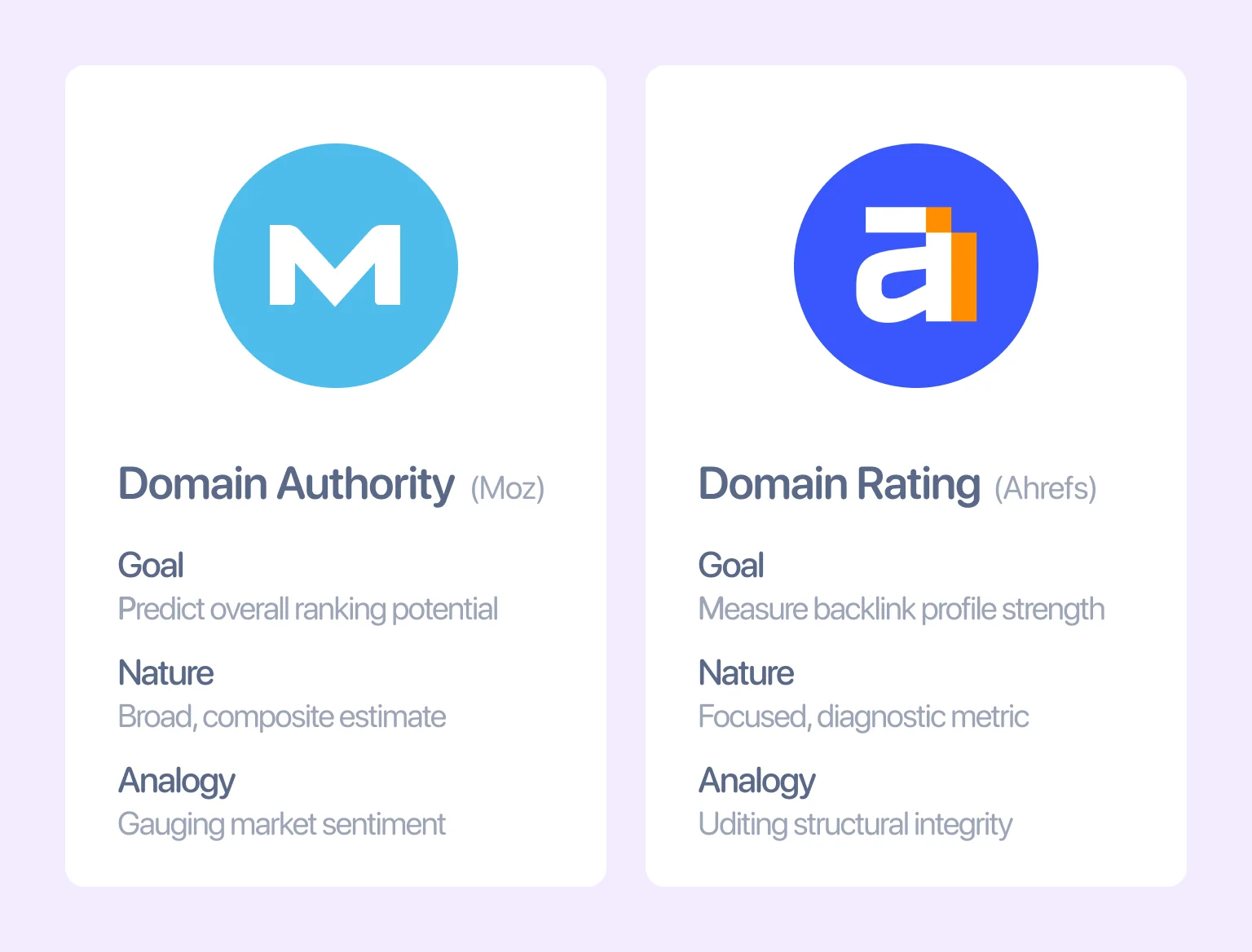
The first difference between DR and Domain Authority (DA) is that the former metric is developed by Ahrefs, whereas the latter is developed by Moz. From a technical standpoint, the two do overlap somewhat. For instance, both factor in backlinks and are scored 0 to 100.
However, there are also significant differences in their purposes and how they affect your website. Most notably, DR focuses on quantifying the underlying strength of your site’s backlink profile. DA is more geared towards predicting your site’s overall search engine ranking. With this key distinction in mind, we can better contextualize DR against other influential indicators in the SEO toolkit.
Domain Rating vs. other SEO metrics
The digital revolution is in full swing, and in such a competitive online ecosystem, SEO metrics have never been more valuable. For that reason, there is no shortage of tools that provide insights to give your site a strategic leg up in the trustworthiness arms race.
Tools such as SEMrush’s Authority Score and Majestic’s Trust Flow offer similar metrics to Ahrefs’ DR, but they are not identical and use different calculation methods, which may influence which is best for the task at hand.
Here’s a brief overview of how DR matches up against other tools:
- Domain Rating. Its targeted, accurate, and up-to-date architecture makes DR an ideal tool for measuring and improving your site’s overall backlink strength, and, in turn, its authority, visibility, and ranking.
- Authority Score. This tool uses a combination of organic traffic, backlinks, spam signals, and behavioral patterns to evaluate your site’s overall SEO health. It’s more holistic than DR and keeps its calculation methods behind closed doors, but it can be helpful when gauging SEO health and how your site stacks up against rivals.
- Trust Flow. It’s geared toward evaluating the quality of the backlinks on your site, which makes it perfect for building trust. That being said, the tool doesn’t factor in backlink quantity, which can lead to overlooking otherwise valuable linking domains.
How Domain Rating is calculated
The calculation hinges on a complex, proprietary algorithm that goes beyond backlink counts to assess the quality and authority of your entire link profile. Understanding the logic behind this scoring allows you to make strategic decisions that directly influence your site’s standing.
Consequently, the following breakdown focuses on the metric’s essential components and the reasons for its inherent volatility.
Core factors affecting DR
In addition to the components that determine how a DR is calculated, many other critical elements significantly influence the metric. Below are some of the most important factors to consider for getting your DR on the right path:
- Linking root domains over total backlinks. Both Ahrefs and Google prioritize links from unique domains over sheer backlink volume. Links from new authoritative sources increase DR more effectively than multiple links from the same domains.
- Geographical diversity. Backlinks from diverse regions can benefit international sites by signaling a natural and well-distributed link profile. Conversely, regionally concentrated links can be just as effective for local or niche websites, helping them to establish authority within their specific geographic or thematic area.
- Topical relevance. Linking to sites related to the content on your webpage is crucial for DR, as it signals a relevant and organic backlink profile. It also indicates trustworthiness, showing that the links are not manipulative.
- Profile diversity and link distribution. Ensuring a balanced spread of links across your site, using diverse anchor texts and link types, helps maintain a natural backlink profile. This approach builds trust and reduces the risk of being flagged as spam.
Why DR can fluctuate
DR is a dynamic metric that is in a near-constant state of flux. The reasons behind these changes are varied but rooted in precise data that is frequently updated and calculated by the tool’s algorithm. Here is what drives fluctuations in DR:
- Changes in your site’s backlink profile, such as lost or new links
- Updates to the Ahrefs algorithm
- An increase in low-quality or spam-like backlinks
- Changes in the authority of the sites that you’re linking to
- Backlinks changing from do-follow to no-follow
- Competing sites have a higher link growth rate
Why Domain Rating matters for SEO
The metric being examined is an integral piece of the puzzle when it comes to SEO strategy. Even though it’s not an official ranking factor for Google, sites with higher DR often rank more prominently because the fundamentals that underpin DR, such as high-quality backlinks, are highly valued by search engine results pages (SERPs).
Correlation between DR and organic rankings
Although not a direct ranking factor, there is a strong correlation between DR and organic rankings. That’s because SERPs like Google prioritize sites that have a strong backlink profile, which is the central pillar of this metric. Hence, pages on higher-DR domains often rank higher, giving them an edge in exposure and traffic because they're perceived as more trusted and authoritative.
DR’s role in building trust and brand credibility
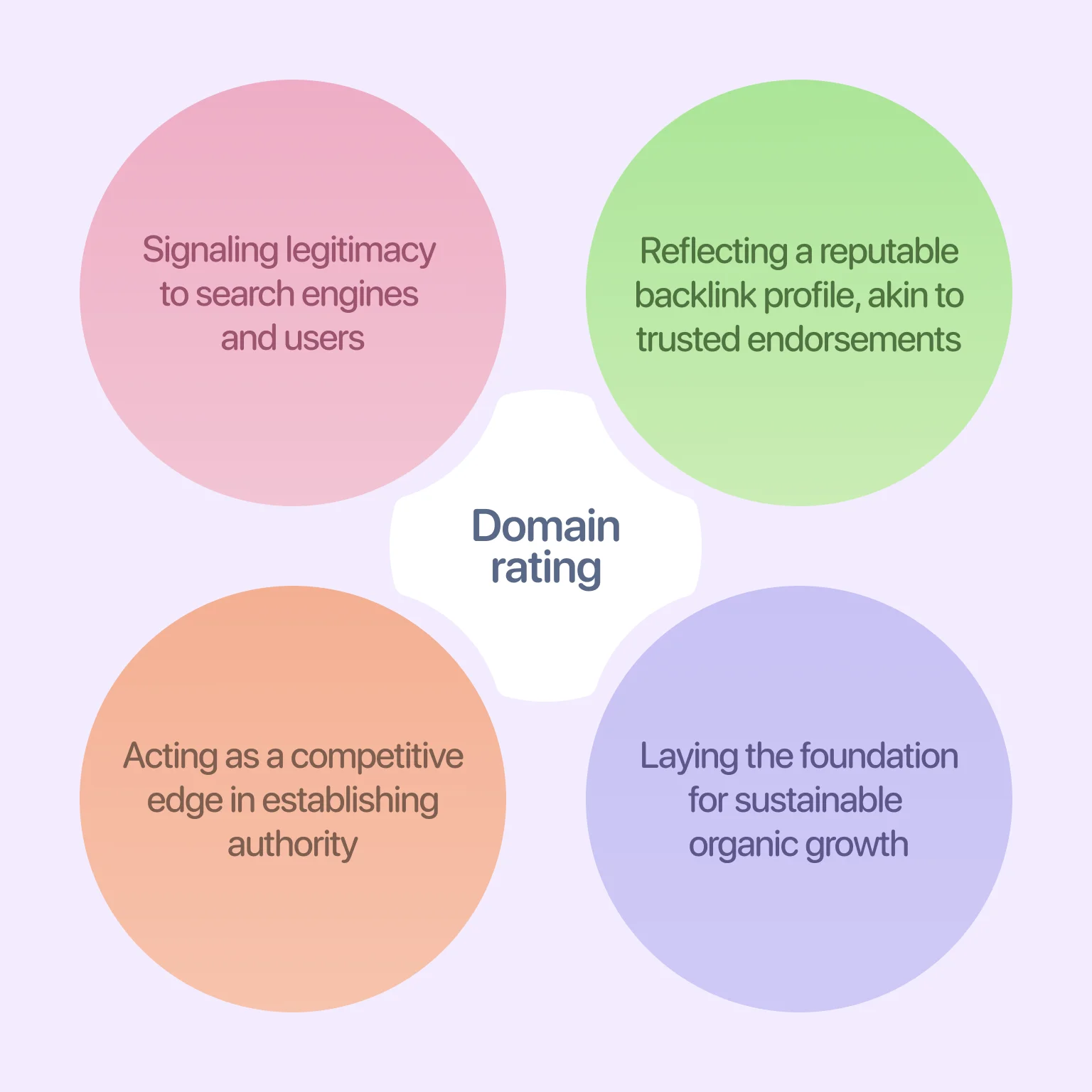
The correlation between DR and organic rankings also extends to trust and brand credibility. The basis for its role in building these important elements remains a high DR, which reflects a strong, reputable backlink profile and signals to both SERPs and users that it’s a legitimate and respected source. In such a competitive landscape, a high DR can be a game-changer for establishing brand trust, credibility, and growth.
When DR doesn’t tell the whole story
The metric is primarily focused on evaluating your site’s backlink profile, and while it’s very effective in this arena, a high score is not a panacea that guarantees high organic traffic. For example, if a webpage has a high DR but is riddled with low-quality content or poor keyword practices, this may offset its strong backlink profile and result in low traffic. What’s more, niche sites with higher metrics may also lag in traffic, given their content is limited to a smaller audience.
“Domain Rating measures earned authority, a critical foundation for visibility, trust, and sustainable SEO growth.”
How to check your Domain Rating
Knowing your DR is non-negotiable for benchmarking your backlink profile against competitors and identifying strategic gaps. To access this data, you must use specialized platforms, ranging from free, quick-check utilities to comprehensive paid solutions. The following sections detail the necessary tools and provide a definitive guide to interpreting the scoring scales.
Free and paid tools to measure DR
This metric is widely regarded as an important indicator across the industry, which means there is no shortage of tools available. Free tools typically have limited features and are best suited for quick DR checks, while paid solutions offer a deeper analysis that will provide clearer, more data-driven insights into how you can improve your score.
Here’s an overview of the best tools:
- Ahrefs offers a limited free version and a range of paid plans.
- SEMrush has a restricted free option and varying paid choices.
- Moz provides a narrow free version and a collection of paid alternatives.
How to interpret the numbers
Receiving your DR is only the first step. But what constitutes a good DR? Understanding how to interpret the numbers is essential for determining where your site stands, why, and where it needs improvement. It’s important to keep in mind that DR scores are relative to both your niche and the tool’s logarithmic scale. Below is a guide as to what constitutes a good, average, and high score:
- Low. Generally, a score of 30 or below is considered low, though if your site is hyper-niche or local, it may be considered a relatively high score.
- Average. Typically, a score in the range of 30–60 falls in the average category. However, to gauge its true position, it should be measured against direct competitors in your respective niche.
- High. For the most part, a score above 60 is considered a high DR, with higher numbers indicating better performance. Once again, benchmarking against competitors is paramount for determining its real-world accuracy in your niche.
Benchmarking against competitors
When formulating an effective strategy to improve DR, benchmarking against direct competitors is a must. Doing so will ensure your goals are realistic and your efforts have a real impact on improving your site’s visibility over rivals. It can also open the door to opportunities by identifying and exploiting competitive gaps, allowing you to tailor your SEO strategy in the most meaningful areas to get the edge.
Knowing how to conduct a competitor analysis is essential in today’s fiercely competitive market. The difference between a strategy that drives growth and a campaign that falls flat often comes down to having an experienced SEO expert.
Strategies to improve your Domain Rating
Now that we’ve covered what a Domain Rating is, it’s time to explore the best strategies for improving it. There are many avenues for doing so, and here’s a rundown of the most effective pathways to maximize outcomes when building up your DR.
Build high-quality backlinks through strategic content marketing
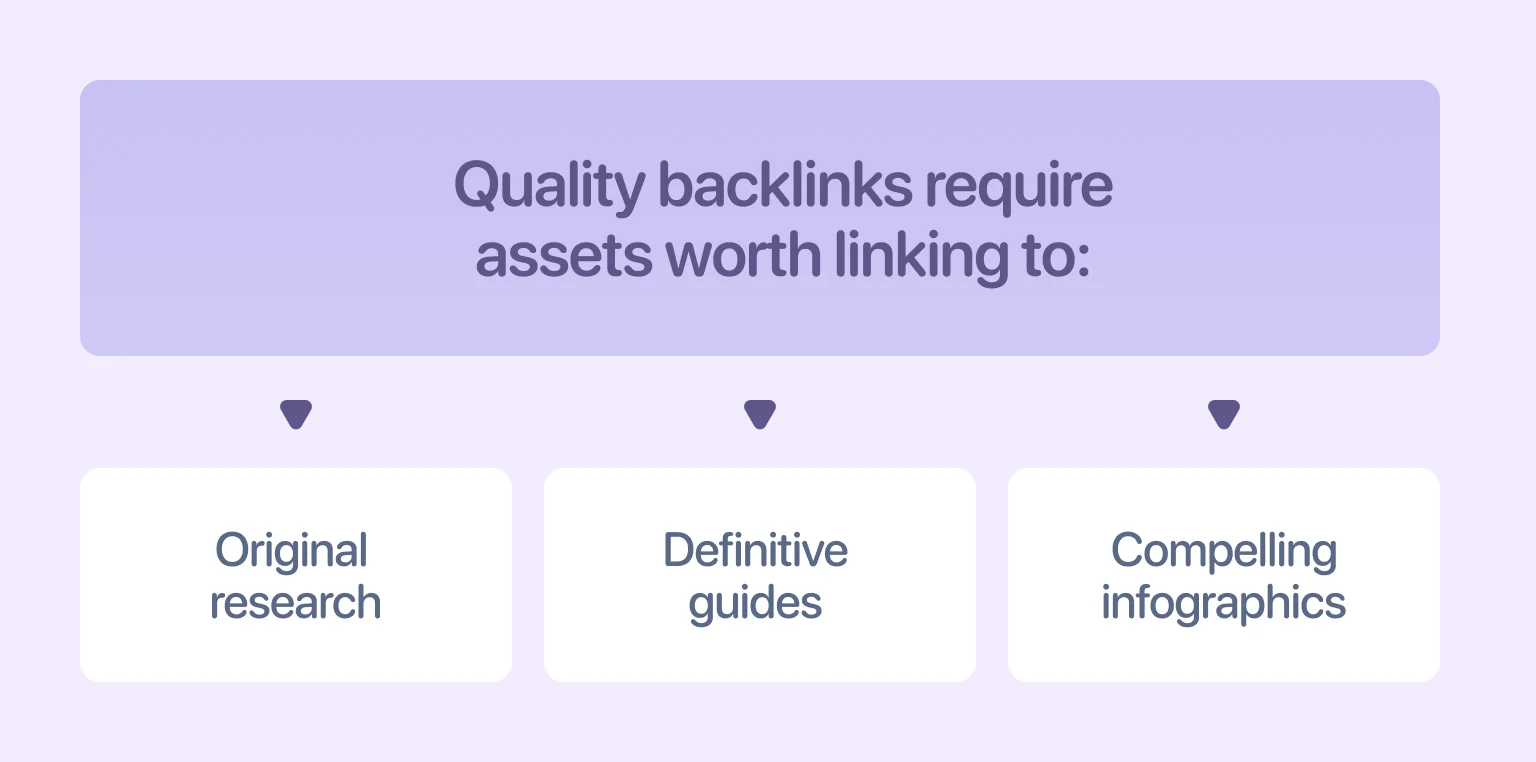
Strategic content marketing is one of the most efficient ways to build high-quality backlinks. By developing linkable assets such as original research, infographics, and in-depth guides, you build a foundation of authority that directly boosts your DR.
Our tailored content marketing solutions will help raise your DR with first-rate content that leaves a strong, lasting impression on your audience.
Fix technical and on-page SEO issues
Technical and on-page SEO issues can be a real headwind when it comes to getting your DR moving in the right direction. Addressing specific challenges, such as site speed and mobile compatibility, can go a long way toward resolving these problems and turning a headwind into a tailwind. Likewise, tightening up on-page elements such as tags, internal links, and headings will also set you up for strong DR growth.
Disavow harmful or toxic links
Harmful or toxic backlinks can hurt your site’s overall search performance. Disavowing low-quality or spammy links won’t directly affect your DR, since it’s calculated by Ahrefs and not Google, but it helps protect your site’s trust and authority for better rankings. Regular audits with tools like Ahrefs or SEMrush make it easy to identify and disavow these toxic links.
Collaborate with industry influencers
Teaming up with trusted influencers in your niche can improve your DR in multiple ways. Namely, it boosts both your site’s reach and credibility within the field and will also help capture more high-quality backlinks. These collaborations immediately translate to authoritative mentions and diverse referral traffic, signaling domain strength to search engines.
Use data-driven link outreach
In the modern business environment, customers have come to expect a certain level of personalization, and improving your site’s DR is not immune to this reality. By using data-driven link outreach, such as personalized pitch templates, you can build meaningful, genuine relationships that attract relationship-based link building, strengthening your backlink profile and DR.
“Improving your Domain Rating is a deliberate process of building trust — by creating undeniable value, forging genuine connections, and carefully curating every signal your site sends.”
How long does it take to improve Domain Rating
The timeline for improving your Domain Rating is subjective and depends on factors such as your site’s technical health and niche competitiveness. Let’s break down the key variables that dictate the pace: the leverage for immediate action and the inherent dynamics of the competitive landscape.
Short-term vs. long-term gains
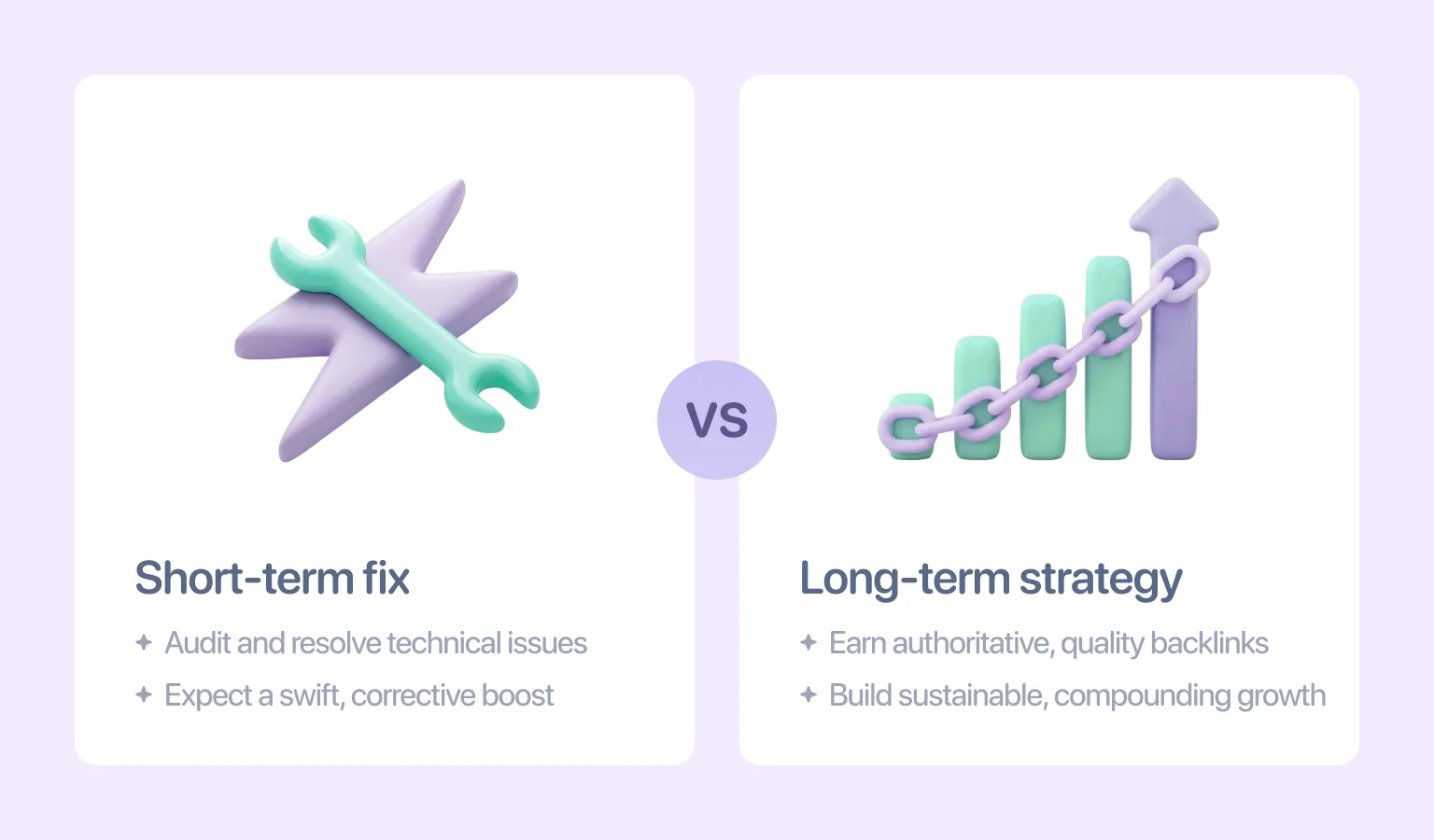
Short-term gains are achieved by identifying and fixing preexisting issues on your site, and once these have been properly resolved, a bump in your DR is a real possibility. On the other hand, long-term gains underpin sustainable growth and are driven by earning high-quality backlinks over time.
Industry and competition factors
How competitive your site’s niche is deeply interwoven with how fast you are able to grow your DR. Simply put, more competitive industries will need more time and effort to raise DR, while ones with less competition have the potential to grow at a much faster rate.
For more in-depth answers to questions like “How long does SEO take?”, “What do you need to do?”, or “How can you unlock new opportunities with our premium keyword research services?”, reach out to our experts and stay ahead of your competitors.
Common mistakes to avoid
Several frequent errors can stall or even reverse your DR progress, often stemming from a misunderstanding of what search engines truly value in a backlink profile. Here are the most common traps that undermine DR growth:
Prioritizing quantity over quality
One of the most common — and damaging — misconceptions is that the sheer volume of backlinks alone can secure a high DR. In reality, prioritizing quantity without assessing the quality of links can actually hurt this indicator rather than help it.
Ignoring relevance in backlink sources
In the same vein, backlinks that deviate from your site’s content or are simply unrelated can also negatively impact your DR. Ensuring that links are sourced from domains that are as relevant as possible to your niche is the remedy to this potential problem.
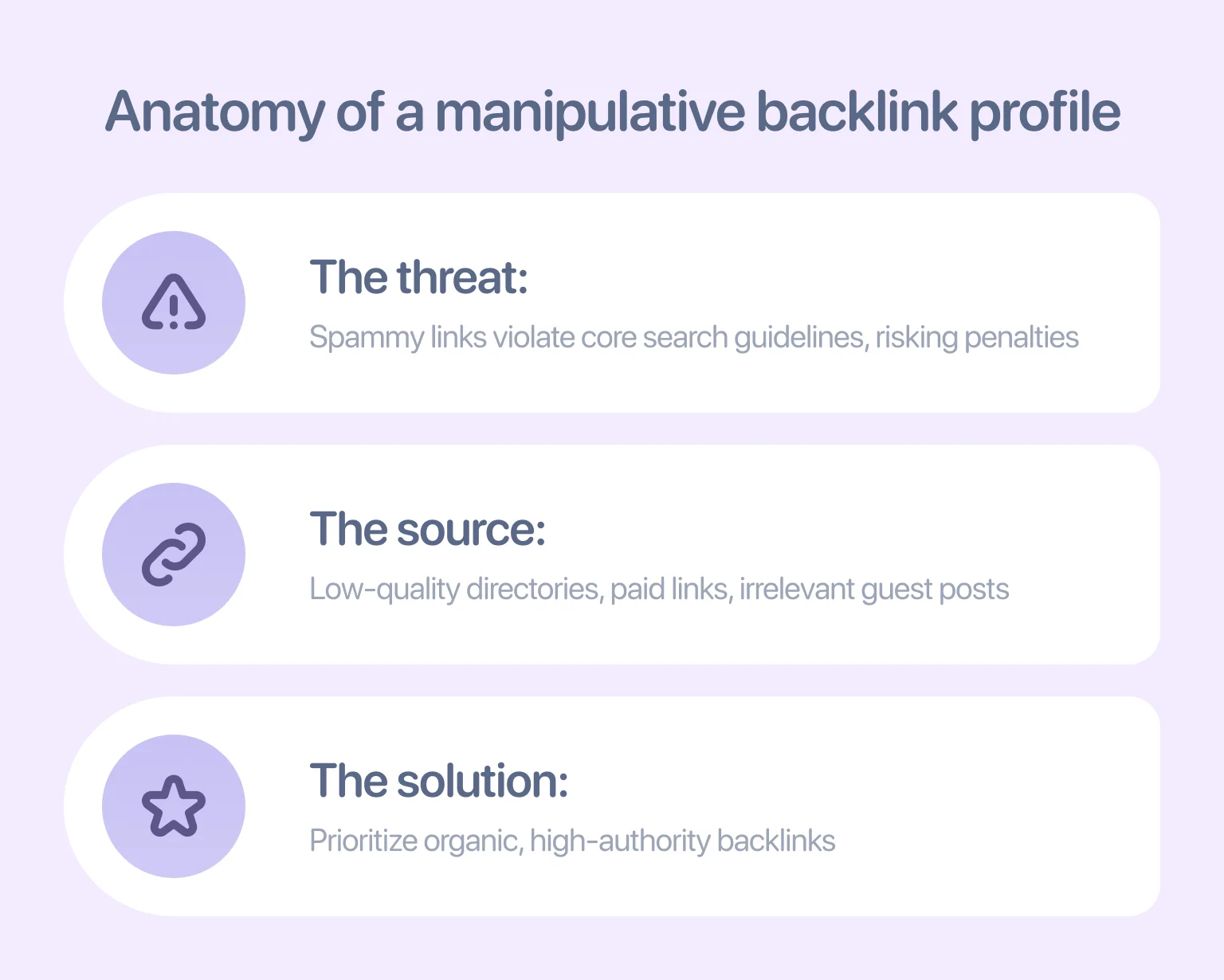
Using spammy or automated link schemes
Resorting to spammy or automated link-building, both of which are considered manipulative practices, violates the core guidelines of major search engines. This puts your site at direct risk of manual penalties and algorithmic demotion. To avoid this, prioritize organic, high-quality backlinks.
Neglecting content value
The quality of your site’s content is always an important factor to consider for DR and SEO, and should not be neglected. For your informational assets to serve as a cornerstone of authority, they must be inherently useful, well-researched, and technically sound.
Tracking and maintaining DR over time
Maintaining a strong DR over time is not a one-and-done process. Rather, it’s a long-term commitment that requires regular monitoring to ensure changes are accounted for, issues are fixed quickly, and sustainable growth remains on course. Let’s outline the ongoing priorities for effective DR stewardship.
Setting realistic targets
Every site and industry is different, so your DR goals will vary. By setting realistic targets based on the current state of your webpage, your specific niche, and its direct competitors, you can help ensure that progress is made and resources are allocated where they are needed most.
Monitoring link health regularly
Harmful links can negatively impact your site’s DR. Regular check-ups of your backlink profile help you identify and remove toxic links before they cause damage. In this regard, Halo Lab’s industry-leading Google Analytics 4 (GA4) service equips businesses with the insights and data-driven strategies they need for meaningful growth.
Continually updating linkable content
Search algorithms and user expectations evolve perpetually. From a DR point of view, this means that linkable content must be continuously updated to remain relevant and valuable, or risk becoming outdated and weakening the DR.
Final thoughts
Domain Rating is a globally respected metric used by industry professionals worldwide, but achieving a high score is only part of the story. For optimal results, focus on sustainable, quality-oriented link building to gain genuine traction and impact. Additionally, while quick fixes may seem attractive, they do not provide a solid foundation for long-term success. A strategy that emphasizes the core principles behind DR is the best approach for steady, lasting progress.
In the end, a strong DR reflects a healthy, authoritative backlink profile. At Halo Lab, we incorporate this principle into every strategy. We collaborate with you to systematically build the link-based authority that enhances your DR and makes it a reliable engine for growth.
FAQ
What is considered a “good” Domain Rating?
While there is no definite answer, as your niche and current site status play a huge role, a score above 60 is generally considered a good DR.
Does Google use Domain Rating as a ranking factor?
Not directly, but there is a strong correlation between high DR and high rankings, due to the weight a strong backlink profile carries.
How often is Domain Rating updated?
Ahrefs is known for frequent updates, and its links database is updated every 15–30 minutes, but the actual DR updates periodically and not in real time.
Can a website with low DR still rank well?
Yes, especially if all other SEO elements are properly implemented. However, a high DR is a significant contributing factor to ranking well.
What’s the difference between DR and URL Rating?
DR is a measurement of your entire domain based on the strength of its backlink profile, while URL rating evaluates only a specific page based on the strength of its backlinks.
Can my DR drop even if I gain new backlinks?
Absolutely, because DR considers all aspects of your backlink profile, including lost links, harmful links, and competitors’ improvement rates, among others.