




Learn why LSI keywords are an outdated SEO myth and explore modern strategies for 2026 including topic clusters, entities schema and user intent.


If your SEO strategy includes hunting for LSI keywords to boost rankings, it’s time for a reality check. Today, search engines read for meaning, context, and intent. But how exactly do they interpret language, and which approaches strengthen SERP positions?
The SEO industry is full of persistent theories that sound technical enough to be true but often lack a solid foundation. This is also the case with LSI terms. For years, digital marketers believed that Google relies on Latent Semantic Indexing (LSI) to judge page quality and relevance. However, modern search systems have far outpaced the capabilities of the technology behind LSI. This article will break down why the industry clung to LSI, how ranking systems function currently, and which strategies outperform obsolete keyword stuffing.
Understanding the origins of LSI keywords
To separate fact from fiction, it helps to look at the technology itself. Latent Semantic Indexing is a mathematical method developed in the late 1980s, well before the World Wide Web existed in its current form. Its primary purpose was to help computers identify relationships between terms and concepts in unstructured text.
Technically known as Latent Semantic Analysis (LSA), this method uses the Singular Value Decomposition (SVD) approach. Imagine a static database of documents. LSI scans it to identify words that frequently occur together. For example, if “monitor” and “keyboard” often appear in the same documents, LSI concludes they are semantically related.
The major limitation in this case is the requirement for a “static database.” When it comes to the internet, billions of new pages are published and updated daily. LSI would need immense computational power to recalculate relationships every time the database changes. For a search engine operating at Google’s scale, applying traditional semantic indexing across the entire web is simply impossible and inefficient.
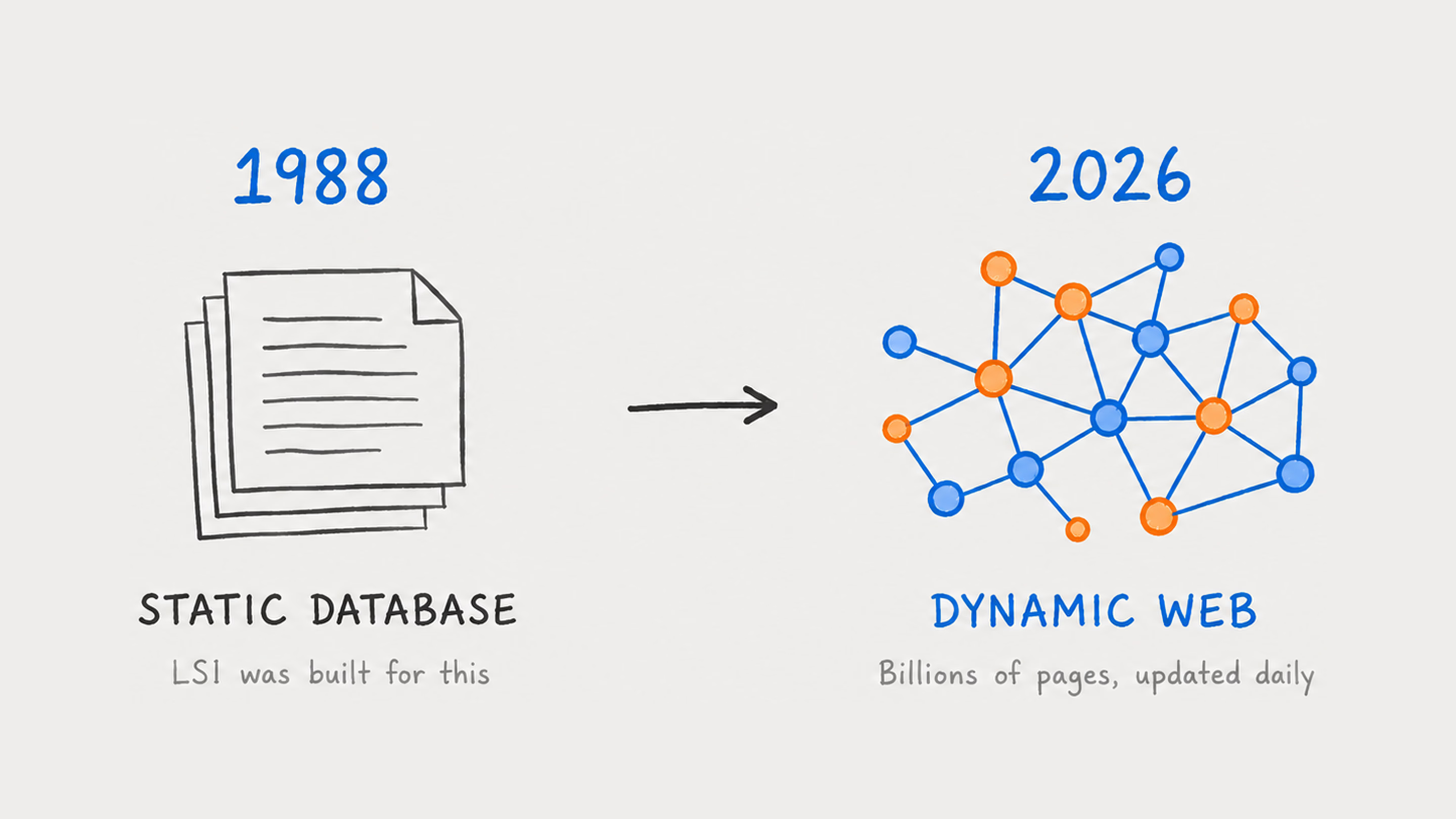
Despite these limitations, several myths about LSI persist in the SEO world:
- Google uses LSI: Senior Google representatives, including John Mueller, have stated that Google does not use it in its ranking algorithm.
- It prevents penalties: Some believe using LSI keywords in SEO protects a site from over-optimization penalties. In fact, writing naturally protects you, not a specific algorithm trick.
- Synonyms equal LSI: SEO tools typically label any related term or synonym as an “LSI keyword,” conflating basic vocabulary with a specific mathematical concept.
“LSI is to Google what a telegraph is to a 5G network. Today, success requires strategies built for the current complex search landscape.”
Why LSI keywords became popular in SEO
If the technology is dated, why did LSI take such a stronghold in the marketing community? The answer lies in the evolution of Google’s algorithm and marketers’ desire for a clear formula to create content.
The shift from exact match to semantic search
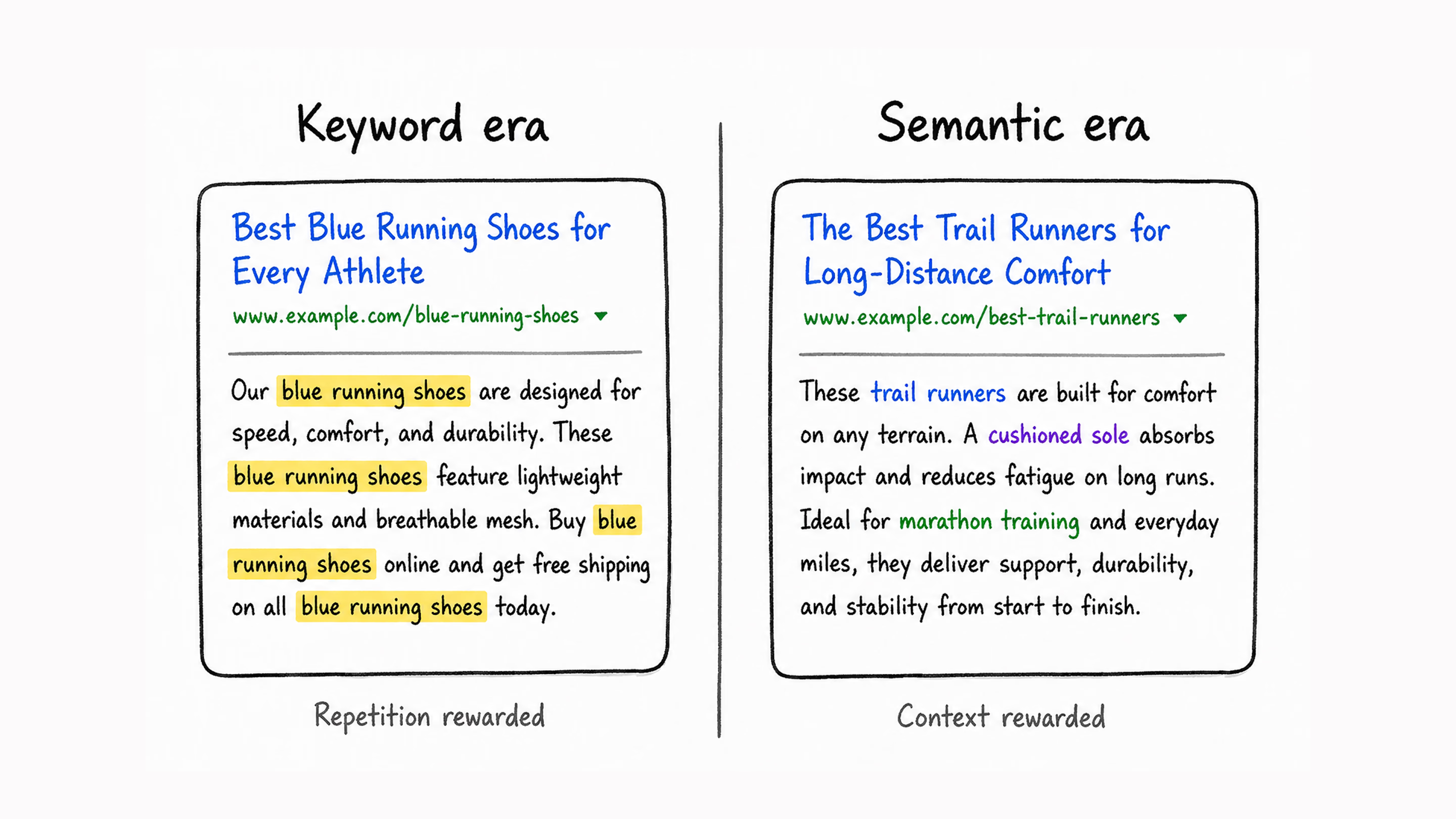
In the early days of SEO, ranking was a numbers game. If you wanted to rank for “blue running shoes,” you repeated that exact phrase as many times as possible. This was the era of keyword density. As Google updated its algorithms (specifically the Panda and Hummingbird updates), it began penalizing this kind of unnatural repetition.
Search engines started rewarding content that thoroughly covered a topic rather than repeating a single keyphrase. SEOs noticed that pages achieving high positions contained a variety of related terms. Lacking a better name for this phenomenon, the industry adopted “LSI” as shorthand for “semanticall related words.”
The role of keyword variations in early ranking factors
Before AI took over, retrieval systems relied heavily on text-based analysis. If a user looked up “automobile,” the engine needed a way to recognize that a page about “cars” was relevant. While not strictly using LSI, early iterations of search algorithms did look for co-occurring terms to establish context.
Marketers needed a way to explain this logic to clients and writers. The concept of LSI keywords offered a scientific-sounding explanation for including words like “vehicle,” “engine,” and “sedan” in a post about cars. It validated the move away from keyword stuffing toward broader vocabulary use.
How SEOs used LSI to expand content
In practice, the LSI concept served as a useful starting point for digital creators. Instead of writing 500 words focused narrowly on one term, they were pushed to include related ones.
Tools soon appeared that scraped the “searches related to” section at the bottom of Google SERPs and labeled those phrases as LSI terms. These lists often helped writers cover subtopics they might have missed. Consequently, the content became more helpful to the reader. The ranking boost that followed was likely due to improved content depth and utility, not because the algorithm was running an LSI check.
Search engines in 2026 — beyond LSI
We have entered a stage where machines read not for pattern matching, but for meaning. Google has transitioned from a lexical search engine (matching words) to a semantic one (understanding intent).
Modern algorithms rely on advanced Natural Language Processing (NLP) models, such as:
- RankBrain: Introduced in 2015, this AI system helps Google interpret queries it hasn’t seen before by connecting them to known concepts.
- BERT (Bidirectional Encoder Representations from Transformers): This allows Google to understand the context of words in a sentence by looking at the words that come before and after them, capturing nuance.
- MUM (Multitask Unified Model): A thousand times more powerful than BERT, MUM can retrieve information across text and images to answer complex queries.
These AI models analyze the relationship between entities. For example, if you write about “Apple,” BERT uses context (like “pie” and “orchard” vs. “iPhone” and “Mac”) to determine whether you mean the fruit or the brand. Therefore, when people apply LSI lists without adapting them to the context, it leads to unnatural writing. For a deeper look at modern optimization techniques, check out our guide on 7 SEO tips.
Are LSI keywords still relevant in SEO?
Strictly speaking, LSI as a technology is irrelevant for Google optimization. However, the principle behind the confusion — using related language to create comprehensive content — remains valid.
The value of related and contextual terms
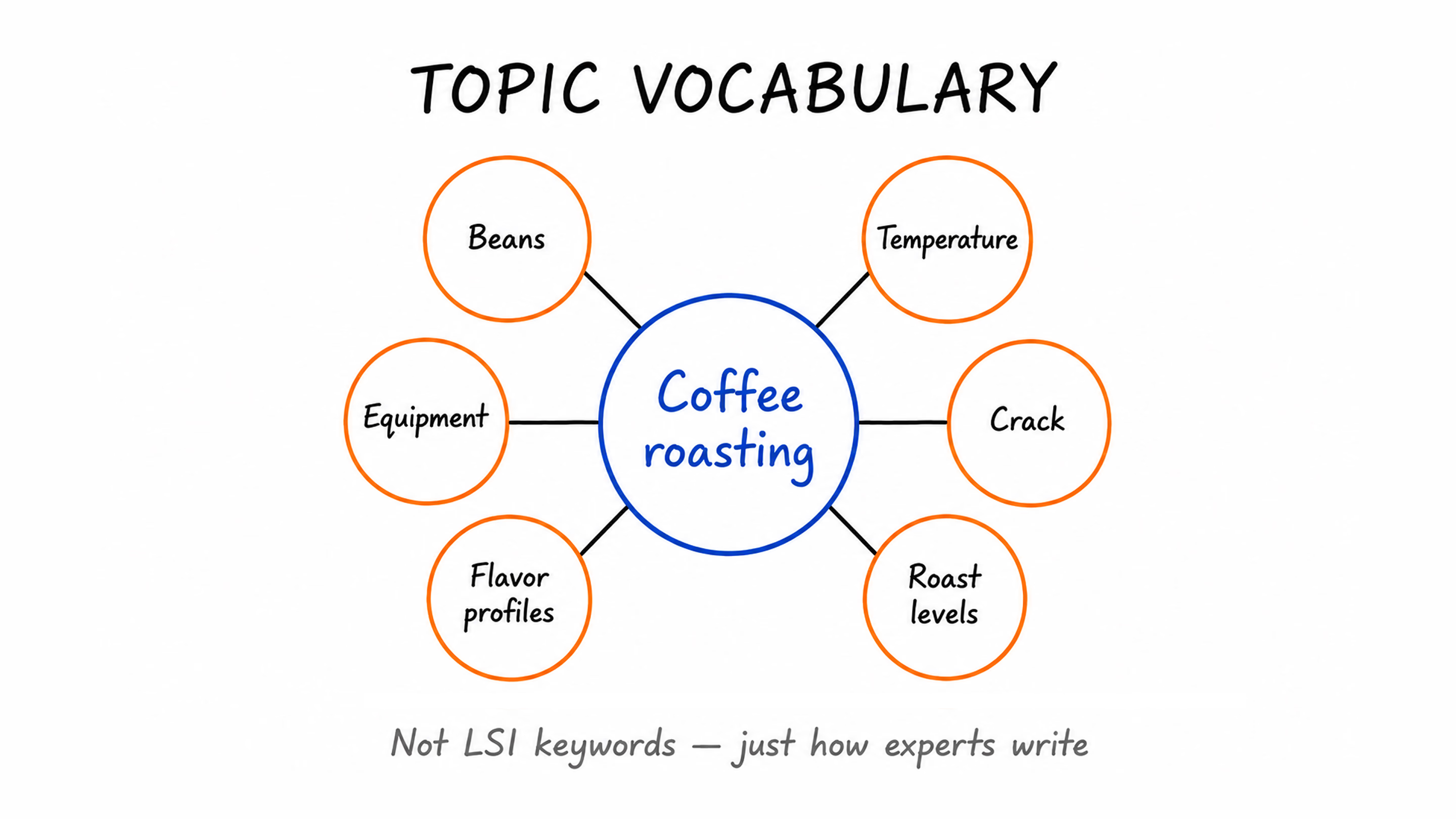
When you write with authority on a subject, you naturally use specific vocabulary. Take, for example, a medical article about “flu symptoms.” It will inevitably contain words like “fever,” “aches,” “virus,” and “hydration.” But these are not LSI keywords that unlock a ranking bonus; they are simply the vocabulary of that topic.
Search engines expect this related vocabulary in an expert article. If a page claims to be a thorough guide to “coffee roasting” but never mentions “beans,” “temperature,” or “crack,” it might be considered low-quality and unreliable. That’s why using semantically relevant terms is crucial to prove you are covering the topic in depth.
User intent vs. keyword stuffing
Problems arise when SEOs prioritize lists over flow. In the past, a keyword strategy often meant forcing a list of 20 LSI terms into an article regardless of whether they fit. However, this approach disrupted the reading experience.
Google’s algorithms heavily weight user experience signals. If a user bounces because the text reads like a dictionary of synonyms, your rankings will suffer. Thus, the focus must shift from “Did I include this word?” to “Did I answer the user’s question?”
What actually replaces the LSI concept
The industry has moved toward semantic search and entity optimization. Semantic keywords help retrieval systems disambiguate meaning and establish topical authority. Unlike the static associations of LSI, semantic relationships are dynamic and based on real-world connections between entities.
“Stop optimizing for strings of characters. Start optimizing for things and concepts.”
Practical alternatives to LSI keywords in 2026
Abandoning the LSI mindset liberates you to focus on strategies that align with current algorithmic capabilities. Here are the three pillars of modern content optimization.
Building topic clusters and pillar content
Instead of trying to rank a single page for every possible variation of a term, opt for a different content strategy — structure your website around topic clusters. This involves creating a central “pillar” page that covers a broad subject deeply, linked to smaller “cluster” pages that explain subtopics in detail.
To illustrate, a pillar page about “digital marketing” would link to specific articles about “email marketing,” “social media,” and “PPC.” Such a structure signals to the search engine that your site is an authority on the entire subject matter. It creates a web of relevance that is far more powerful than individual keyword optimization.
In practice, consider a SaaS company offering project management software. Their pillar page might cover “project management” broadly — methodology, team structure, and tools. Cluster pages would then address specific subtopics: “how to run a sprint planning session,” “Kanban vs. Scrum,” “remote team collaboration tools.”
Each cluster page links back to the pillar and to related clusters. Over time, this architecture signals to Google that the site covers the subject with genuine depth — because it answers the full range of questions users actually ask.
{{banner}}
Applying entities and knowledge graphs in optimization
Google stores information in a format called the Knowledge Graph, which connects “entities” (people, places, things, concepts).
To optimize for entities:
- Identify the entity. Be clear about who or what you are discussing.
- Use attributes. If the person is “Leonardo da Vinci,” attributes include “Mona Lisa” (artwork), “The Last Supper” (artwork), “Louvre Museum” (location), and “Renaissance” (time period).
- Establish relationships. Connect your main topic to other related elements within the text.
Writing with entities in mind ensures that Google can confidently place your content within its Knowledge Graph. This increases the likelihood of appearing in rich snippets and AI overviews. If you want to improve your semantic optimization, pay attention to our on-page SEO solutions that can help you implement entity coverage systematically across your site.
As a concrete example, a financial advisory firm writing about “compound interest” should not just define the term. It should connect the concept to related entities — “Warren Buffett” (who famously described it as the eighth wonder of the world), “index funds” (a common vehicle for compound growth), and “retirement planning” (the most common application).
Each of these connections gives Google additional signals about the page’s topical territory. A page that exists within a rich network of entity relationships is far more likely to be surfaced in AI-generated answers than one that covers the same term in isolation.
Implementing schema and structured data markup
The most direct way to speak Google’s language is through schema markup. This is code you add to your website that explicitly tells the search platform what your content means. Instead of hoping Google understands that “Avatar” is a movie, you can use the movie schema to tell them.
A schema can define articles, products, events, organizations, and FAQs. It forms the technical backbone of semantic SEO, reducing ambiguity and helping you capture enhanced visibility in SERPs. If schema implementation feels complex, technical SEO support makes it straightforward to get structured data right from the ground up.
To make this concrete: an e-commerce site selling coffee equipment can use Product schema to tell Google the item’s name, price, availability, and review rating — information that then appears directly in search results as rich snippets, without the user needing to click through.
An FAQ schema on the same site’s brewing guide page allows individual questions and answers to expand directly in the SERP. Each schema type removes a layer of interpretation Google would otherwise have to perform on its own, making it faster and more confident about surfacing the right content to the right user at the right moment.
The pillars described above work together as a cohesive system rather than isolated tactics. For a deeper look at how to plan and execute content optimization specifically, the SEO content strategy guide walks through the process step by step.
Why LSI keyword stuffing backfires
Consider a local auto repair shop trying to rank for “car brake repair.” An LSI-driven strategy might lead them to cram the page with loosely related phrases from keyword tools: “vehicle stopping system,” “road safety,” “driving control,” and “automotive performance.” The result sounds unnatural: “Our vehicle stopping system solutions improve driving control and road safety performance.” Visitors quickly sense the awkward wording and leave, hurting engagement and rankings.
A semantic approach, by contrast, would focus on what customers actually need to know about brake repair: warning signs of worn brakes, repair costs, service time, safety checks, and maintenance tips. If you run a local business, working with a local SEO specialist can help you build a content strategy around what your customers actually search for — rather than what keyword tools suggest.
Best practices for SEO without LSI keywords
Relying on LSI keywords is a thing of the past. What does SEO success require these days? Let us show you how to optimize content effectively without leaning on the LSI crutch.
Focus on user intent over keyword variants
User intent is the goal behind a search query. It usually falls into one of the following categories:
- informational (wanting to know);
- navigational (wanting to go);
- transactional (wanting to do);
- commercial investigation (wanting to buy).
Simply put, if a user searches “how to fix a leaky faucet,” their user intent falls into the navigational category — they want a tutorial, not a history of plumbing (informational category). Your marketing efforts should prioritize answering that specific need. If you solve the problem efficiently, Google will recognize the relevance regardless of specific synonym density.
Leverage SERP analysis for semantic clues
The best source of data is the search results page itself. Google has already ranked the content it considers most relevant. So, what you should do is analyze the top 5 outcomes for your target query.
- What subheadings do they use?
- What questions are they answering?
- What images or videos are included?
This analysis reveals the “semantic footprint” of the topic. If all top results discuss “washer replacement” and “water pressure,” these are the topical gaps you must fill.
Content gaps, questions, and related topics
What are users interested in? To find specific questions, you should use tools like “People Also Ask.” Then, answering these questions directly builds topical authority. Furthermore, apart from the topical gaps you must fill, identify topic gaps that your competitors missed. When you provide a unique perspective or data point, this adds value that simple keyword optimization cannot replicate. Building topical authority consistently takes time — our monthly SEO service is built for teams who want steady progress without managing the process themselves.
The future of SEO and semantics
The trajectory of search is clear: it is moving further away from keywords and closer to conversation.
Generative AI and the evolution of search
With the rise of Google’s AI Overviews, users often get answers without clicking a link. To survive in this environment, content must be highly authoritative and structured. AI summarizes information based on consensus and credibility. Being the source of that information requires fact-rich material.
Conversational and entity-based search
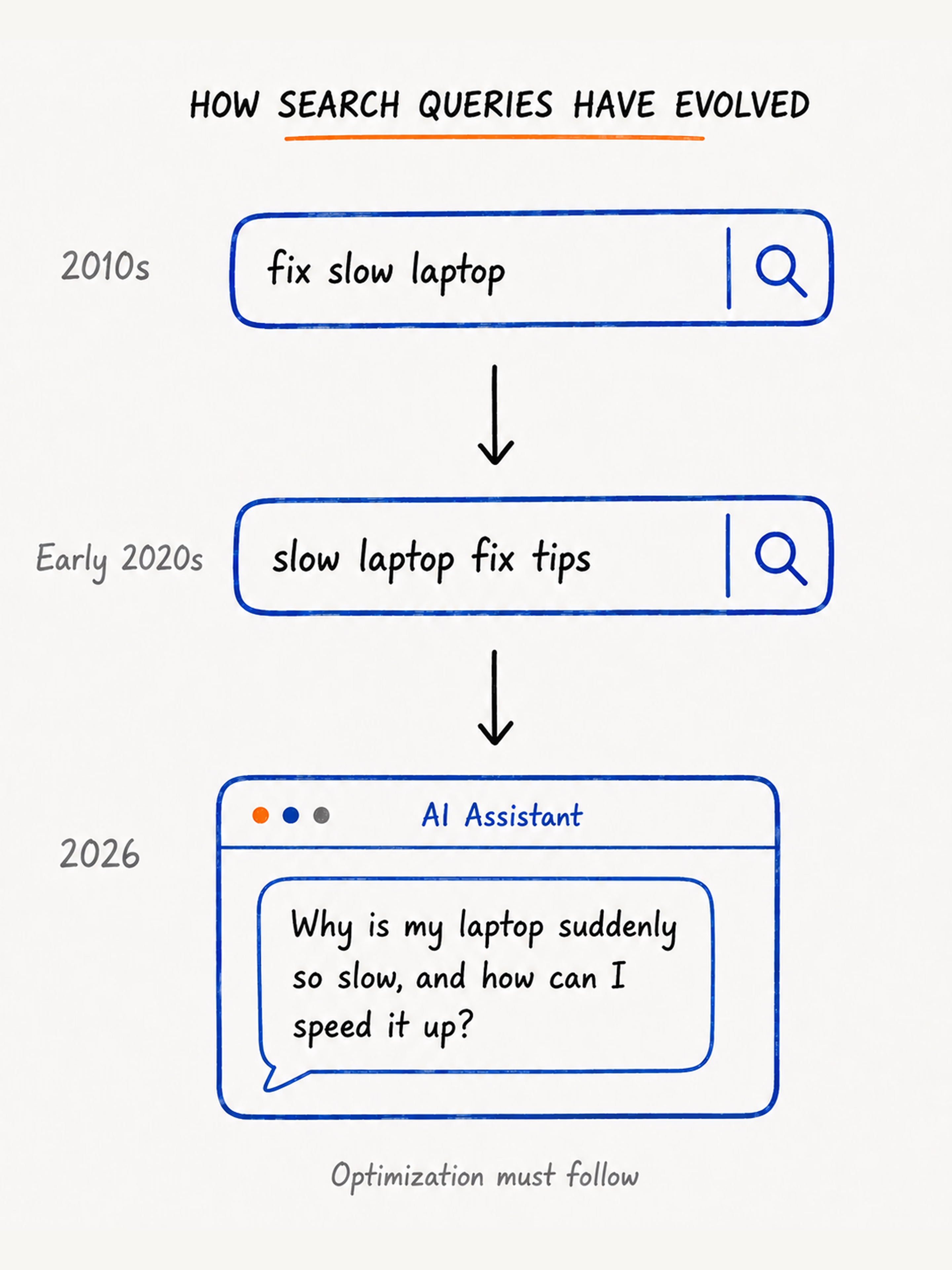
Voice search and conversational AI (like ChatGPT) encourage natural language queries. People don’t type “fix slow laptop,” they ask, “Why is my laptop suddenly so slow, and how can I speed it up?” Search engines must parse complex sentence structures. Optimization means writing in a conversational tone that directly answers these long-tail queries.
Core ranking principles will remain (E-E-A-T)
Regardless of the technology, Google’s core principle remains E-E-A-T: experience, expertise, authoritativeness, and trustworthiness. No amount of research into LSI or semantic tricks can outweigh the value of credible proficiency. The proof is in outcomes — working with a tutoring service in the education sector, Halo Lab ran a strategy built around technical foundations, content depth, and E-E-A-T signals rather than keyword lists. The result was a 28% increase in organic traffic and top 3 rankings for key queries during peak season — and the growth is ongoing.
“Algorithms change overnight. The value of expertise lasts forever.”
From keyword stuffing to authority building
By now, it’s clear that chasing LSI keywords is a distraction in modern SEO. While the intention — to create relevant material — is right, the method is flawed, and the terminology is technically incorrect. Google no longer relies on simple keyword patterns. It uses sophisticated AI models to understand entities, context, and the purpose of the search.
The pattern we see most consistently across client projects is clear. Teams that organize content around topical authority and user intent outperform those still optimizing for keyword lists alone — often by a significant margin. At Halo Lab, we help brands build strategies that go beyond rankings: driving real traffic, boosting visibility, and keeping content aligned with how search actually works.
{{banner-2}}
FAQ
Should I still add LSI keywords to my blog posts?
No, you should not intentionally “add” LSI keywords based on outdated lists. Instead, focus on covering the topic comprehensively. This way, relevant vocabulary and synonyms will appear in your writing naturally.
What’s the best replacement for LSI keywords in SEO?
The best replacement is entity SEO and topic clusters. Concentrate on identifying the main entities (people, places, concepts) relevant to your subject and mapping out the relationships between them. Structure your content to cover the main topic and related subtopics thoroughly.
How can I find semantic keywords or entities for my content?
You can find semantic terms by analyzing the “People Also Ask” section, looking at Google Autocomplete, and reviewing the top-ranking page for your target query. Additionally, tools like Google Trends and Wikipedia can help you visualize how topics and entities are connected.
Is using synonyms the same as using LSI keywords?
Not exactly. Using synonyms is a natural part of writing and helps with readability and simple keyword variation. LSI was a specific mathematical method for finding relationships in a database. While SEOs often use the terms interchangeably, using synonyms is good for writing style, while “LSI” as a ranking factor is a myth.
How does AI-driven search impact keyword use?
AI-driven search prioritizes context and intent over specific keyword matches. It creates a boost for content that answers questions directly and clearly. This means exact-match keywords are less important, and natural language that mimics how humans speak is more effective.
What are the risks of relying on outdated LSI strategies?
The main risk is creating low-quality content that reads unnaturally, leading to poor user engagement. Additionally, focusing on LSI lists can waste time that should be spent on higher-impact strategies.